HCP First Draft
He Zhang
Professor Greg McClure
Writing 39C
July 19, 2015
Animal Testing: Keep or Avoid?
The history of animal testing can go back to Greek in the 4th and 3rd centuries BC that Aristotle and Erasistratus are among the first to do experiments on living animals. In 12th century, an Arabic doctor named Ibn Zuhr introduced the animal testing as an experimental method to test the risk of surgical operations before utilizing in human patients. For United States, the use of animal testing in a research became exceedingly vital to Americans in twentieth century, especially when it was used for a pharmaceutical drug testing. With the development of technology, although scientist are not relying on animal testing as great as before, animal testing is still a necessary part of researches that it can not only test for medicines, but also for cosmetics, even for household products. When people enjoy the safety and credibility of the results of animal testing brings to our daily life, do we ever consider just for a little moment that such kind of testing on living animals is also a cruel behavior to them. There is no denying that animal testing helps lots of physicians and doctors make countless contributions on each fields, like medicine, chemistry, biology, etc. However, testing on animals should be keep or avoid is a really controversial problem that people need to figure out clearly, at least getting a general conclusion. From my perspective, despite the fact that animal testing has brought a lot of benefits to our lives so far, it should be avoided and people need to find another way to replace it.
“Relationship Between Animals and Humans”
The relationship between animals and humans is kind of mutually beneficial as well as harmful. As what Marc Bekoff describes, an emeritus professor at the University of Colorado, Boulder and a co-founder of Ethical Treatment of Animals, the bond between animals and humans can be considered as a messy and confusing affair. We know that more and more people raise small animals as their pets nowadays as well as many animal protection organizations have been set up. People who have pets or desire to have own pets can say they like animals without hesitation. They treat them as lovely, cute companions. More exaggerated, I saw some people regard pets as their own babies, even some people choose to have a pet rather than have a child. With no doubt, people are animal lovers at that time; however, at mean time, people also harm them intentionally in research, entertainment, food and clothing. According to the report from the article “Animal Research and Testing”, around 855 million chickens are slaughtered for meat in the United Kingdom every year and about 95 percent of them are kept indoors densely in vast sheds with harmful conditions. In China, with the rapid expansion of living standards, the meat depletion has greatly increased from 20kg to 50kg per person per year, which means more animals need to be killed for the meat market. With the almost same growing rate of pet owners and meat demand, people keep saying that they love animals, particularly they claim the dogs as the most loyal friends to humans, but they brutally hurt them by killing them in the name of some other things, such as living needs, safety needs, even natural needs. This contradictory statement seems to the most curious, funniest phenomenon nowadays.
“Wide Use of Animal Testing”
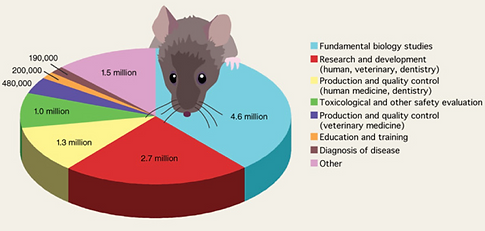
The use of animal testing is becoming more and more wider, in education and training, in cosmetic and household products. The picture below shows the various uses of animal testing in different fields of science and life.
Millions of rats, rabbits, cats, dogs and some other kind of animals are kept inside the cold, dry cages in the laboratories right now. They are waiting for the unknown destiny, being killed by the lab testing or luckily survive after cruel testing. Around and around terrifying and painful actions will apply on them. These animals suffer pain, accept loneliness, and ramble without mind. As we know, animal testing, by definition, refers to use animals in experiments and development projects. It helps scientists to determine toxicity of drug, chemical ingredients of food or daily products before people use. With the wide spread of animal testing, it has been applied in most areas. “In 2010, about 40% of NIH (National Institutes of Health)-funded grants and contracts involve animal research.” An estimated 25 million or more animals, including rats, chicken, pigs, are used in all areas of research, testing, and education every year in U.S. Animal testing commonly used in researches brings lots of benefits in humans’ life. Nevertheless, not every animal can be used for testing; the testing animal should have similar body structure as humans in order to get a more accurate result. In addition, “as originally conceived, a valid model of human health concerns, the animal disease must have the same biological mechanisms, symptoms, and responses to treatment as the theoretically similar human counterpart” written in the article “Animal Research and Testing”.
Works Cited
“Animal Research and Testing.” Neavs. Web.
Bekoff, Marc. "Should Animals Be Used in Laboratory Testing? (Op-Ed)." livescience. Web. November 11, 2013
Scutti, Susan. “Animal Testing: A Long, Unpretty History.” Medical Daily. Web. Jun 17, 2013
Sharp, Rob. “The Curious Relationships Between People and Animals.” Nzherald.co.nz. Web. October 11, 2010

HCP Final Draft
He Zhang
Professor Greg McClure
Writing 39C
July 19, 2015
Animal Testing: Keep or Avoid?
The history of animal testing can go back to Greek in the 4th and 3rd centuries BC that Aristotle and Erasistratus are among the first to do experiments on living animals. In 12th century, an Arabic doctor named Ibn Zuhr introduced the animal testing as an experimental method to test the risk of surgical operations before utilizing in human patients. For United States, the use of animal testing in a research became exceedingly vital to Americans in twentieth century, especially when it was used for a pharmaceutical drug testing. With the development of technology, although scientist are not relying on animal testing as great as before, animal testing is still a necessary part of researches that it can not only test for medicines, but also for cosmetics, even for household products. When people enjoy the safety and credibility of the results of animal testing brings to our daily life, do we ever consider just for a little moment that such kind of testing on living animals is also a cruel behavior to them. There is no denying that animal testing helps lots of physicians and doctors make countless contributions on each fields, like medicine, chemistry, biology, etc. However, testing on animals should be keep or avoid is a really controversial problem that people need to figure out clearly, at least getting a general conclusion. From my perspective, despite the fact that animal testing has brought a lot of benefits to our lives so far, it should be avoided and people need to find another way to replace it.
“Relationship Between Animals and Humans”
The relationship between animals and humans is kind of mutually beneficial as well as harmful. As what Marc Bekoff describes, an emeritus professor at the University of Colorado, Boulder and a co-founder of Ethical Treatment of Animals, the bond between animals and humans can be considered as a messy and confusing affair. We know that more and more people raise small animals as their pets nowadays as well as many animal protection organizations have been set up. People who have pets or desire to have own pets can say they like animals without hesitation. They treat them as lovely, cute companions. More exaggerated, I saw some people regard pets as their own babies, even some people choose to have a pet rather than have a child. With no doubt, people are animal lovers at that time; however, at mean time, people also harm them intentionally in research, entertainment, food and clothing. According to the report from the article “Animal Research and Testing”, around 855 million chickens are slaughtered for meat in the United Kingdom every year and about 95 percent of them are kept indoors densely in vast sheds with harmful conditions. In China, with the rapid expansion of living standards, the meat depletion has greatly increased from 20kg to 50kg per person per year, which means more animals need to be killed for the meat market. With the almost same growing rate of pet owners and meat demand, people keep saying that they love animals, particularly they claim the dogs as the most loyal friends to humans, but they brutally hurt them by killing them in the name of some other things, such as living needs, safety needs, even natural needs. This contradictory statement seems to the most curious, funniest phenomenon nowadays.
“Wide Use of Animal Testing”
The use of animal testing is becoming more and more wider, in education and training, in cosmetic and household products. The picture below shows the various uses of animal testing in different fields of science and life.
Millions of rats, rabbits, cats, dogs and some other kind of animals are kept inside the cold, dry cages in the laboratories right now. They are waiting for the unknown destiny, being killed by the lab testing or luckily survive after cruel testing. Around and around terrifying and painful actions will apply on them. These animals suffer pain, accept loneliness, and ramble without mind. As we know, animal testing, by definition, refers to use animals in experiments and development projects. It helps scientists to determine toxicity of drug, chemical ingredients of food or daily products before people use. With the wide spread of animal testing, it has been applied in most areas. “In 2010, about 40% of NIH (National Institutes of Health)-funded grants and contracts involve animal research.” An estimated 25 million or more animals, including rats, chicken, pigs, are used in all areas of research, testing, and education every year in U.S. Animal testing commonly used in researches brings lots of benefits in humans’ life. Nevertheless, not every animal can be used for testing; the testing animal should have similar body structure as humans in order to get a more accurate result. In addition, “as originally conceived, a valid model of human health concerns, the animal disease must have the same biological mechanisms, symptoms, and responses to treatment as the theoretically similar human counterpart” written in the article “Animal Research and Testing”. Thus, why rats are always the favorite animals that scientists like to use in the testing.
“Avoiding Animal Testing”
Avoiding animal testing is a part of way to build a human-animal bond without cruelty behaviors. The total number of animal testing has been increased 2% from 2010 to 2011 based on the report of national statistics and it is almost over 3.79 million.
Universities and medical schools are becoming the biggest consumers of animals testing. There is no denying that it is an essential part of scientific studies that students and researches need to observe and test animals to make a conclusion or progress on human evolution. Nevertheless, people must consider a very simple question: What if we change the position of animals and we are the one who are being tested by others, how will we feel. The answers are definitely quite similar that it should be banned and it is immoral. “Although the U.S. Food and Drug Administration does not require animal safety testing for cosmetics—a category that includes skin cream, perfume, makeup and shampoo—animal tests are still used”(Moran, Locke). Even though animal testing is not require to test for things we need to use in our daily life, the law asserts that “every pesticide must undergo dozens of separate animal tests before it can be marketed”, which means that many animals will still suffer and undergo the death. We must admit there are several advantages of animal testing, like keeping the products safe for people, making contributions to medical studies, but it does not mean that we can ignore the great painful animal going through during the testing because testing on animals is not only a cruelty to animals, but also a non-human behavior to people; thus, we should avoid it. Ironically, about ninety percent of drugs fail on people even they have passed the animal testing before. It is not just a question about whether it is moral or not; it is more likely about there are plenty of reasons to push away from animal testing, not just from the side of ethics. People always talk about how important animal testing in our lives; yet, with the development of technologies and human knowledge, animal testing can be equaled or replace by some other testing methods, such as genetic or cells testing. “Over the last 10 years, we’ve started replacing rodents with human cells in drug toxicity tests” (Biba). Although humans’ structures have little different from mice or chimpanzees, it is still a progress on the path of non-animal testing.
Today, hundreds of cosmetics and household-product companies are starting to get rid of animal testing and trying to find an alternative way to have some sophisticated non-animal testing methods for their products. Moreover, around March of 2013, the news claims that “The European Union (EU) has banned the sale of any cosmetics or cosmetics ingredients that have been tested on animals” as well as Australia, Japan. That means almost all cosmetics or something related to cosmetics will no longer tested on animals. There are more and more bills and policies coming out to stop or limit experiments on animals. Eliminating animal testing become eventually feasible which open an invisible protecting umbrella to animals.
“Conclusion”
In sum, I will never contradict that there must some animal testing will remain scientifically necessary for a long period of time; however, I insist my point that people need to avoid animal testing no matter the result of animal tests are reliable, applicable to humans or not, people should never do such awful things to animals because they are part of living creatures on the planet, just the same as humans. Treating them like humans, even can consider them as friends may be a wonderful way to finish animal testing.
Work Cited
“Animal Testing: Why the Number of Procedures Is Increasing.” theguardian. Web.
Bekoff, Marc. "Should Animals Be Used in Laboratory Testing? (Op-Ed)." livescience. Web. November 11, 2013
“Cosmetics and Household-Product Animal Testing.” Peta.org. Web.
Erin Biba. “How to Get Rid of Animal Testing. From Chimp to Chip.” Popular Science. Web. December 5, 2013
Jim Moran, Paul A.Locke. “Beauty and the Beasts: The U.S. Should Ban Testing Cosmetics on Animals.” Scientific American. Web. May 28, 2014.
Scutti, Susan. “Animal Testing: A Long, Unpretty History.” Medical Daily. Web. Jun 17, 2013
Sharp, Rob. “The Curious Relationships Between People and Animals.” Nzherald.co.nz. Web. October 11, 2010
“Product Testing: Toxic and Tragic.” Peta.org. ANIMALS ARE NOT OURS. Web.
“Animal Research and Testing.” Neavs. Web.

Changes Between Drafts
HCP First Draft
1. Do not satisfy the required length
2. Lack of specific details to describe the problem
3. MLA formatting errors
4. Paragraph structures are off
5. Using definition as topic sentence
6. Kind of far away from the topic subject
HCP Final Draft
1. Add two more paragraphs to fit the requirement and become more comprehensive
2. Add some details to show what specific problem in animal testing
3. Double-space the essay
4. Split the paragraph to make it more clearly
5. Change the mode of experession to write in the same meaning
6. Delete something unuseful and try to foucus on the topic